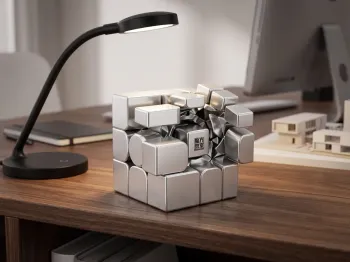
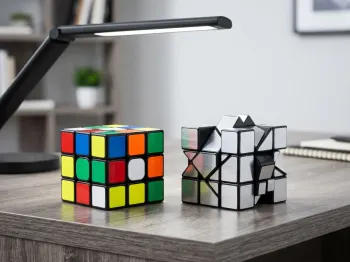
7 Stunning Mirror Cube Patterns That Will Look Amazing on Your Shelf
Transform your Mirror Cube into art! Discover 7 stunning patterns like the Superflip and Cube-in-a-C...
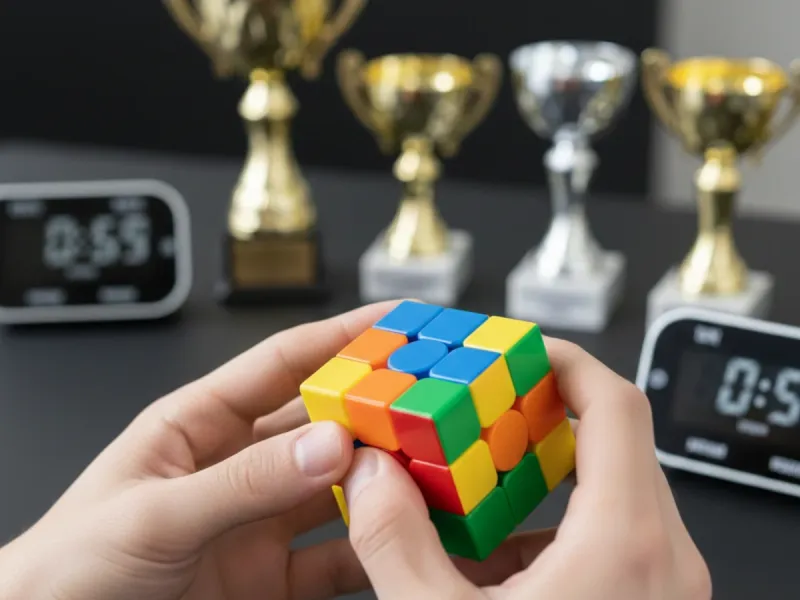
Speedcubing looks like magic to the uninitiated. To the average observer, a cuber’s hands move in a blur of plastic and color, solving a chaotic mess in under ten seconds. This visual spectacle has given rise to a mountain of myths—misconceptions that often discourage beginners from even trying to improve.
Today, we’re going to strip away the fiction and look at the reality of how to improve your solve times. Whether you are stuck at a minute or pushing for sub-20, understanding the truth about the hobby is the first step toward mastery.
This is perhaps the most persistent myth in the world of twisty puzzles. People assume that speedcubers are doing complex mental calculus mid-solve. In reality, speedcubing is 90% muscle memory and pattern recognition. You aren't calculating; you are reacting. Your brain recognizes a specific case (a pattern of colors) and triggers a programmed sequence of moves (an algorithm) that your fingers execute without you having to think about each individual turn.
While "TPS" (Turns Per Second) is important, it is rarely the bottleneck for intermediate cubers. The most common reason solves are slow isn't because the hands are slow, but because the brain is pausing between steps. This is called "recognition time." If you can turn at 10 TPS but pause for two seconds between every F2L pair, a person turning at 3 TPS with no pauses will beat you every time.
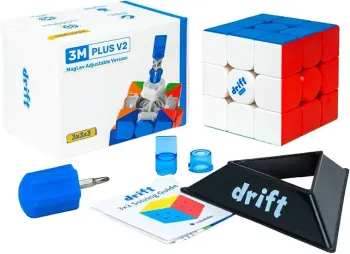
To reduce these pauses, you need a cube that doesn't catch or lock up. For those looking for a reliable, smooth experience without breaking the bank, a high-quality magnetic option like the Cubelelo Drift 3M Plus v2 3x3 is a fantastic choice. Its MagLev technology reduces friction, allowing you to focus on your look-ahead rather than fighting the hardware.
There is a saying that "it’s the wizard, not the wand." While skill is the primary factor, hardware acts as a ceiling. An old, non-magnetic store-bought cube will physically limit how fast you can turn and how accurately you can finish a move. Magnetic cubes provide "alignment," meaning the layers click into place even if your turn is slightly inaccurate.
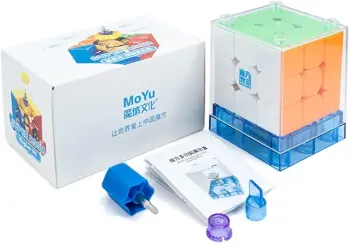
If you are serious about improving, moving to a cube with advanced internal tech, such as the Cubelelo MoYu Super RS3M Ball-Core, can drastically reduce your error rate. The ball-core provides 360-degree magnetic attraction, offering a level of stability that standard cubes simply can't match.
It sounds counter-intuitive, but to get faster, you must solve slowly. By turning at a pace where you never have to stop, you train your eyes to look for the next piece while your hands are busy solving the current one. This is the secret to "Look-Ahead."
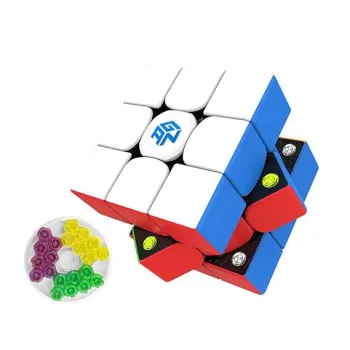
Don't just learn an algorithm; drill it until your fingers move automatically. If you have to say "R U R' U'" in your head, you haven't mastered it yet. High-end equipment like the GAN 356 M is often preferred for algorithm drilling because of its lightweight design and premium tactile feedback, which helps in developing precise muscle memory.
The First Two Layers (F2L) is the most time-consuming part of the CFOP method. Instead of just memorizing cases, try to understand how the pieces move. Use intuitive F2L to learn the mechanics, then move to advanced algorithms to shave off those final few seconds.
To reach your full potential, having a cube that matches your skill level is essential. Here are our top picks for cubers at different stages:
Speedcubing isn't about being a genius; it's about disciplined practice and using the right tools. Ignore the myths, start drilling your F2L, and watch your times tumble!