7 Stunning Mirror Cube Patterns That Will Look Amazing on Your Shelf
Transform your Mirror Cube into art! Discover 7 stunning patterns like the Superflip and Cube-in-a-C...
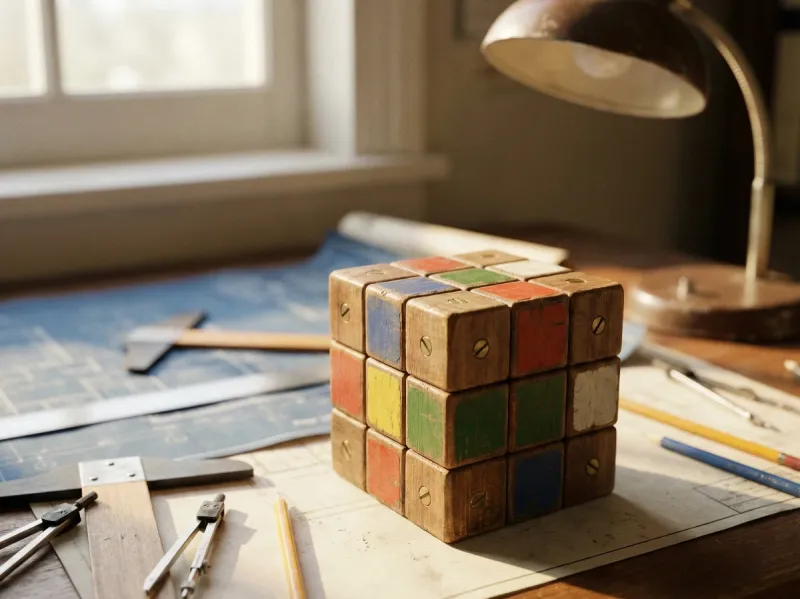
The Rubik's Cube is one of the world's best-selling toys, with over 450 million sold worldwide. But this iconic puzzle didn't start as a toy at all—it began as a teaching tool created by a Hungarian architecture professor. Here's the remarkable story of how a simple classroom aid became a global cultural phenomenon.
In 1974, Ernő Rubik, a 29-year-old professor at the Academy of Applied Arts and Crafts in Budapest, faced a teaching challenge. He wanted to help his students understand 3D space and structural design. The result was a 3×3×3 cube with colored sides that could rotate independently while staying together.
What Rubik didn't expect was his own struggle to solve it. After scrambling the colors, he spent over a month figuring out how to return each face to a single color. That moment of solving his own creation marked the birth of the world's most popular puzzle.
Rubik patented his invention in 1975, initially calling it the "Magic Cube" (Bűvös kocka in Hungarian). It was first sold in Hungarian toy stores in 1977, quickly becoming popular locally but remaining unknown internationally.
In 1979, toy specialist Tibor Laczi spotted the cube at a Budapest trade fair and recognized its potential. He brought it to the attention of Ideal Toy Corp., which agreed to market it internationally. The company renamed it "Rubik's Cube" to honor its creator and make it more marketable.
When Rubik's Cube launched globally in 1980, it sparked unprecedented mania:
The cube attracted serious mathematical attention:
Like many fads, the initial craze faded. By 1983, sales plummeted, and the cube seemed destined for obscurity. Warehouse sat filled with unsold inventory. Many considered it a dead trend, a relic of the early 80s.
The internet breathed new life into cubing:
Today's cubing scene is radically different:
The Rubik's Cube has transcended its status as a toy:
Now in his 70s, Ernő Rubik remains active in design and education. His creation has made him one of Hungary's wealthiest citizens and most famous innovators. He continues to advocate for hands-on, playful approaches to learning and problem-solving.
The original 3×3×3 spawned an entire family:
The Rubik's Cube's longevity stems from several factors:
From a Hungarian classroom to a global phenomenon, the Rubik's Cube's journey mirrors its own complexity—full of twists, turns, and surprising solutions. What started as one professor's teaching aid has impacted millions of lives, launched a global community, and continues to challenge and delight people of all ages.
Want to become part of this rich history? Start your journey with our beginner's guide and join a tradition spanning five decades!