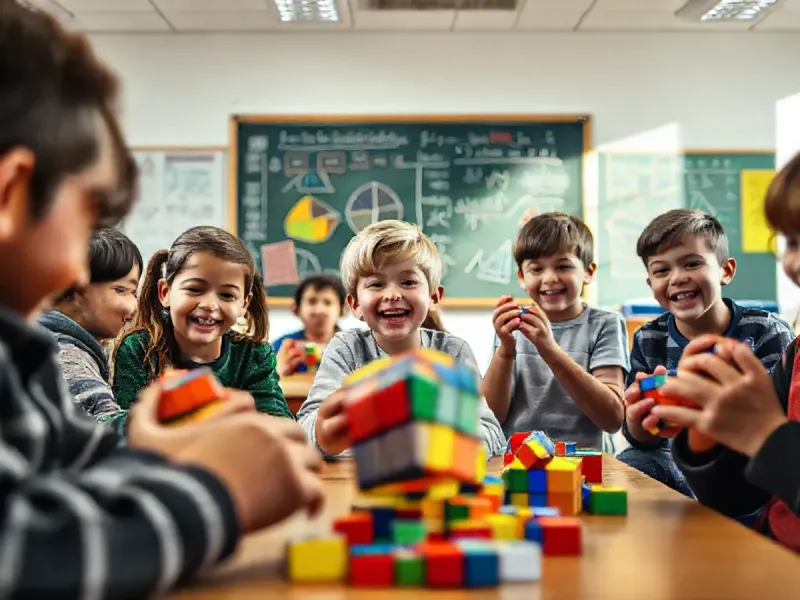
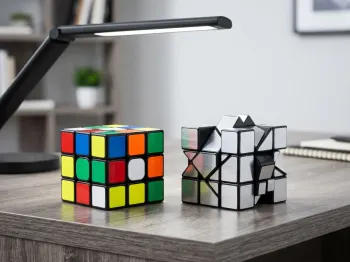
The Rubik's Cube is making a major comeback, not just as a toy, but as a powerful educational tool in classrooms around the world. Teachers are discovering that this simple puzzle is a perfect vehicle for teaching core STEM (Science, Technology, Engineering, and Mathematics) concepts in an engaging, hands-on way.
Why the Rubik's Cube is a Perfect STEM Tool
- Engaging: It captures students' attention far more effectively than a textbook.
- Hands-On: It provides a physical representation of abstract concepts.
- Low Cost: Cubes are affordable, making them accessible to any school.
- Differentiated Learning: It can challenge students at all levels, from beginners to advanced problem-solvers.
Mathematics in Every Turn
The cube is a goldmine for mathematical exploration:
- Algorithms: Students learn what an algorithm is and how to follow a sequence of steps to achieve a result.
- Permutations & Combinations: They can discuss the 43 quintillion possible scrambles.
- Geometry: It's a tangible object for teaching concepts of 3D space, axes of rotation, and spatial reasoning.
- Group Theory: For advanced high school students, it serves as an introduction to abstract algebra.
Technology and Engineering Principles
The cube also connects to technology and engineering:
- Problem Decomposition: Students learn to break a large, complex problem (a scrambled cube) into smaller, manageable sub-problems (layers, crosses, pairs). This is a fundamental concept in software engineering.
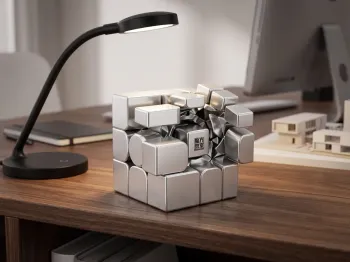
- Design & Mechanics: Students can disassemble a cube to see its internal mechanism, learning about structural design and mechanics.
- Robotics: Many schools are building cube-solving robots, combining programming, mechanics, and computer vision.
Developing 21st-Century Skills
Beyond specific STEM subjects, using Rubik's Cubes in the classroom fosters critical life skills:
- Grit and Perseverance: Students learn that it's okay to fail and that persistence is key to solving difficult problems.
- Growth Mindset: They see that with practice and the right strategy, they can master something that once seemed impossible.
- Focus and Concentration: The cube requires sustained attention, helping students build their ability to concentrate.
- Collaborative Problem-Solving: Students often work together, teaching and learning from each other.
How to Implement Rubik's Cubes in the Classroom
Teachers are using programs like 'You CAN Do the Rubik's Cube' which provide free resources:
- Curriculum Guides: Lesson plans that align with math and STEM standards.
- Cube Lending Programs: Free sets of cubes for schools to borrow.
- Teaching Resources: Step-by-step guides and videos designed for classroom use.
A typical classroom implementation might look like this:
- Introduction: Students learn the basics and the beginner's method.
- Practice: Time is dedicated to practicing and helping each other.
- Competition: A friendly in-class or school-wide competition is held.
- Extension Activities: Students can explore mosaic building, mathematical concepts, or even cube-solving robots.
Conclusion
The Rubik's Cube is proving to be far more than a distraction in the classroom. It's a dynamic, effective, and fun way to teach essential STEM principles and life skills. By turning abstract concepts into a tangible challenge, teachers are inspiring the next generation of problem-solvers, engineers, and mathematicians, one colorful cube at a time.