7 Stunning Mirror Cube Patterns That Will Look Amazing on Your Shelf
Transform your Mirror Cube into art! Discover 7 stunning patterns like the Superflip and Cube-in-a-C...
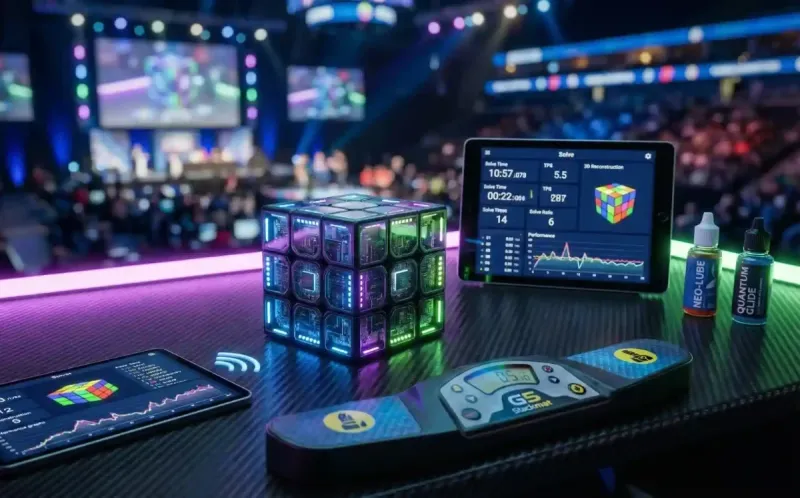
For decades, becoming a faster cuber meant one thing: endless repetition. We would sit for hours with a standard cube, a handheld stopwatch, and a notebook full of handwritten times. While the fundamentals of practice haven't changed, the tools at our disposal have undergone a massive technological revolution. Today, if you want to break the sub-20 or even sub-10 second barrier, relying solely on old-school methods is like bringing a knife to a laser fight.
Modern technology has introduced precision, data analytics, and interactive coaching into the world of cubing. By leveraging these tools, you can identify specific weaknesses in your cross, F2L, or OLL transitions that were previously invisible to the naked eye.
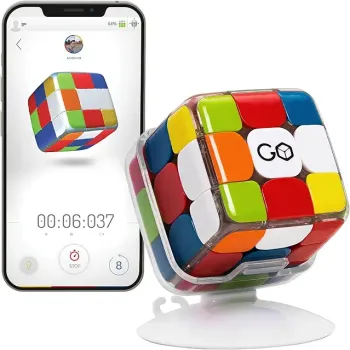
The most significant leap in cubing tech is the invention of the Smart Cube. These devices look and feel like high-performance speedcubes but contain internal sensors and Bluetooth connectivity. Instead of just timing your whole solve, a smart cube like the GoCube Edge Full Pack - Connected Smart Cube tracks every single move, rotation, and TPS (turns per second) metric in real-time.
With a smart cube, you can analyze your 'split times' automatically. The accompanying apps show you exactly how long you spent on each stage of the CFOP method. This data is invaluable because it tells you exactly where you are losing time—whether it's a slow cross-to-F2L transition or a hesitant AUF (Adjust Upper Face) at the end of a solve.
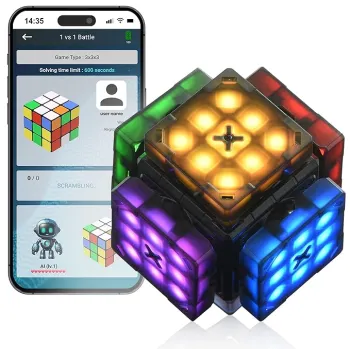
Artificial Intelligence has also made its way into the palms of our hands. Beyond just tracking moves, some devices act as interactive tutors. For younger cubers or those looking for a versatile training partner, the eX-Mars Connect | AI Robot Cube & Smart Cube, Self Scrambling STEM Cube with 10 Puzzle Types | Self Solving Speed Cube, Plays Music | Great X-Mars Experience for Kids, Teens & Adults offers a unique experience. It is a self-scrambling, AI-powered robot cube that can guide you through solves and even play music, making the often-tedious process of learning new algorithms much more engaging.
These AI-driven tools help bridge the gap between 'knowing' an algorithm and 'mastering' it. They provide immediate haptic or visual feedback when you make a mistake, ensuring that you don't build bad muscle memory—a common pitfall of traditional practice methods.
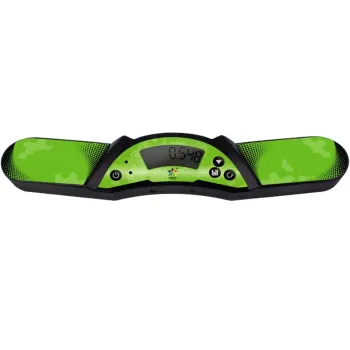
While smartphone apps are convenient, they don't prepare you for the physical reality of a WCA (World Cube Association) competition. In a real tournament, you aren't tapping a screen; you are using a specialized touch-sensitive mat. To truly shave seconds off your PB, you need to practice your 'pickup' and 'drop' technique.
Using a Speed Timer for Cube, Professional Touch Control with Display and Voice Sound Effect, Automatic Calculation Timer for Competition allows you to practice the physical transition from timer to cube. This professional-grade gear includes automatic calculation and voice sound effects to keep you focused. For those who want the industry standard used in many official settings, the Speed Stacks Stackmat Pro Timer Gen 3 (Black) is another excellent choice that offers the precision required for high-level training.
Even the best technique can be hindered by a cube that catches or feels sluggish. Modern cubing isn't just about the electronics; it's about the chemistry of the hardware. To keep your cube performing at its peak, professional lubricants have replaced the generic silicone oils of the past. For best results, consider using a specialized formula like the SpeedCubeShop Stardust Professional Speed Cube Lubricant 5ml, which is designed to provide a fast, 'stardust' feel that lasts through hundreds of solves.
The journey from a beginner to a pro cuber is faster today than it has ever been. By integrating smart cubes for data analysis, AI for interactive learning, and professional timers for competition simulation, you can optimize every minute of your practice. Stop guessing where you're slow and start using the tech that shows you exactly how to get faster.