7 Stunning Mirror Cube Patterns That Will Look Amazing on Your Shelf
Transform your Mirror Cube into art! Discover 7 stunning patterns like the Superflip and Cube-in-a-C...
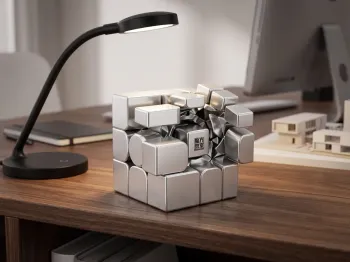
For anyone who has ever picked up a Rubik’s Cube, the six colors—white, yellow, red, orange, blue, and green—are the fundamental language of the puzzle. You learn to recognize color patterns, execute algorithms based on those hues, and eventually solve the cube in record time. But then, you see it: a shimmering, monochromatic block of silver or gold that doesn’t just scramble its colors, but physically transforms into a jagged, unrecognizable mess. This is the Mirror Cube.
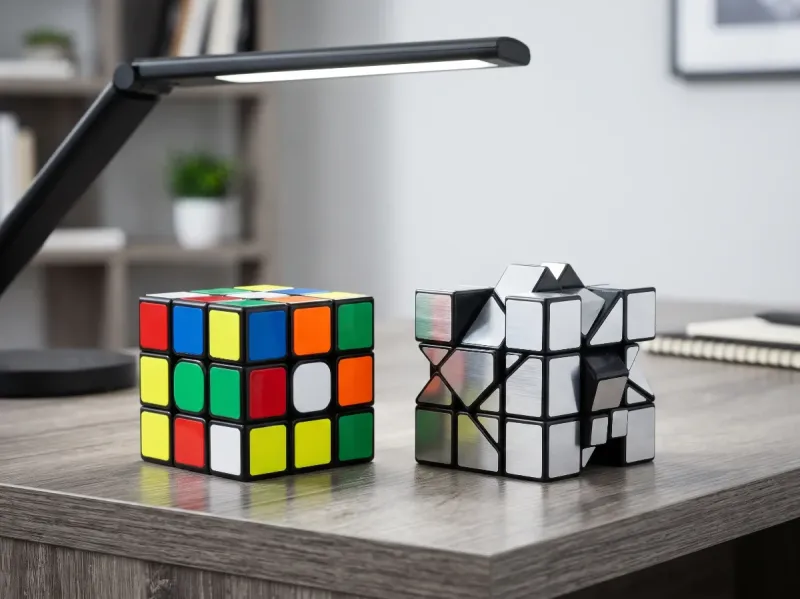
While the Mirror Cube (also known as the Mirror Blocks or Bump Cube) uses the exact same internal mechanism as a standard 3x3, the experience of solving it is fundamentally different. In this guide, we’ll dive deep into the comparison between the standard 3x3 and its shape-shifting cousin, exploring why geometry changes the game and how you can master both.
The most obvious difference is the visual stimulus. On a standard 3x3, every piece of a specific type (corners or edges) is the same physical size. A red-white edge is identical in shape to a blue-yellow edge. Your brain becomes wired to ignore the shape and focus entirely on the stickers. This is why many speedcubers can solve in low light or even with worn-out stickers—the color contrast is what drives the solve.
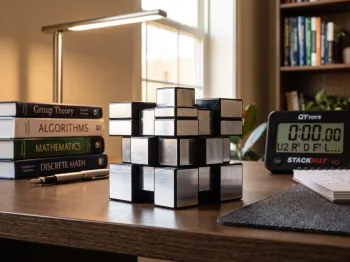
The Mirror Cube throws this out the window. Instead of colors, the pieces are defined by their dimensions. Every piece has a unique height, width, and depth. When you turn a layer, the pieces protrude at different lengths, creating a "shape-shifting" effect that can be incredibly intimidating for beginners. Solving it requires you to stop looking for colors and start looking for depth.
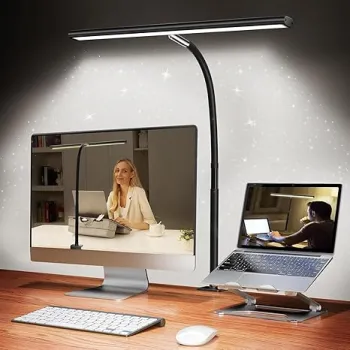
To succeed with a Mirror Cube, you need a workspace that allows you to see these subtle depth differences clearly. Shadows can be your worst enemy when trying to distinguish between two pieces that are only a millimeter apart in thickness. This is where high-quality lighting becomes essential. For the best visual clarity, many cubers find that using a dedicated light like the Airlonv LED Desk Lamp for Office Home, Eye-Caring Desk Light with Stepless Dimming Adjustable Flexible Gooseneck, 10W USB Adapter Desk Lamp with Clamp for Reading, Study, Workbench (Dark Black) helps highlight the edges and surfaces of the metallic pieces, making the recognition phase much faster.
If you already know how to solve a standard 3x3 using the Layer-by-Layer method or CFOP (Cross, F2L, OLL, PLL), you technically already know how to solve a Mirror Cube. The move notation—R, L, U, D, F, B—is identical. However, the mental friction comes from the center pieces.
On a standard 3x3, the centers never move relative to each other, and they are all the same size. On a Mirror Cube, the centers are also fixed, but they are offset. One center is very thin, while the opposite center is very thick. Identifying which side is which is the first major hurdle. If you don't align the pieces to the correct center depth, the cube will never return to its perfect cubic state.
This added layer of spatial reasoning makes the Mirror Cube an excellent tool for brain training. It forces you to visualize the puzzle in three dimensions rather than just mapping colors on a 2D surface.
For years, Mirror Cubes were considered "novelty" puzzles. They were often clunky, prone to locking up, and lacked the smooth turning of modern speedcubes. However, that has changed recently with the introduction of high-performance shape mods. Modern engineering has finally caught up to the shape-shifter.
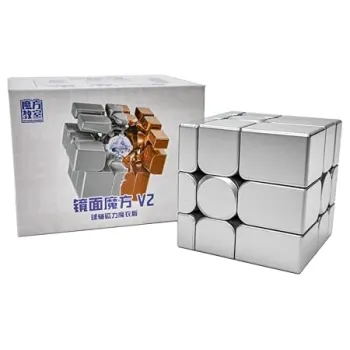
A popular choice among collectors and serious solvers is the MoYu Mirror Cube 3x3 V2 Magnetic Ball-Core Shape Mod | Silver UV Coated Finish & Auto-Alignment | Premium Stability, Smooth Turning & Anti-Pop Mechanism : Amazon.in: Toys & Games. Unlike older versions, this model features a magnetic ball-core and UV coating, which provides the stability and smooth turning usually reserved for professional-grade 3x3s. The magnets help the cube "snap" into place, which is vital when the cube is in its scrambled, jagged form and difficult to grip.
Because a Mirror Cube solve typically takes longer than a standard 3x3 solve—especially when you are first learning to recognize shapes—you might find yourself hunched over your desk for extended periods. The tactile nature of the puzzle means you are often rotating the cube in your hands more frequently to check piece heights from different angles.
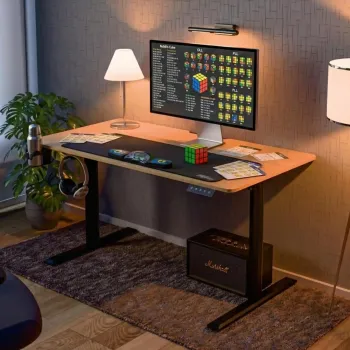
To prevent neck and back strain during long sessions of shape-mod solving, an ergonomic setup is key. Using a height-adjustable surface like the Green Soul Imperium Height Adjustable Table for Office Work | Everyday Ergonomic Desk with One Piece Top | Advance Memory Preset | 3 Year Warranty | Installation Provided (GreyOak,1100 x 600 Top) allows you to switch between sitting and standing, keeping your blood flowing and your focus sharp as you tackle complex puzzles.
Can you speedcube with a Mirror Cube? Absolutely. While the world record for the 3x3 is under 4 seconds, the world records for the Mirror Cube are significantly higher (usually in the 10-15 second range for top-tier solvers), simply because shape recognition is inherently slower than color recognition.
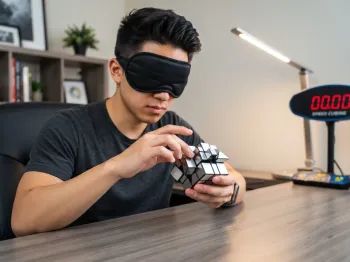
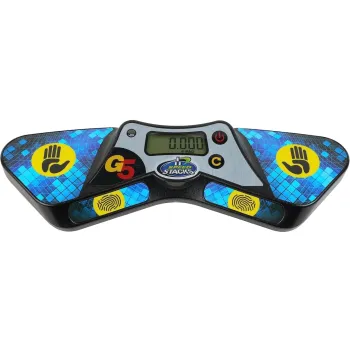
If you want to transition from casual solving to speed-solving the Mirror Cube, you need to treat it like a sport. This means practicing your finger tricks and, most importantly, timing your solves to track progress. Even though you aren't hitting sub-5 second times, using a professional timer like the Speed Stacks Stackmat Pro Timer Gen 3 (Black) is the best way to ensure accuracy and build the pressure needed to improve your recognition speed.
If you are a beginner, the Standard 3x3 is where you must start. It is the foundation of all cubing knowledge. You need to understand the logic of the pieces before you try to solve them by size alone.
However, once you can solve a 3x3 comfortably, the Mirror Cube is the ultimate next step. Here is why:
The battle between the Mirror Cube and the Standard 3x3 isn't about which is "better," but about how they complement each other. The standard 3x3 builds your algorithmic muscle memory and speed, while the Mirror Cube tests your patience and spatial perception. Whether you're looking to shave seconds off your PB or simply want a puzzle that looks stunning in its solved state, having both in your collection is essential.