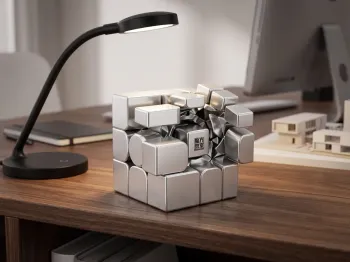
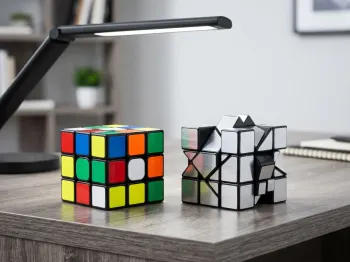
7 Stunning Mirror Cube Patterns That Will Look Amazing on Your Shelf
Transform your Mirror Cube into art! Discover 7 stunning patterns like the Superflip and Cube-in-a-C...
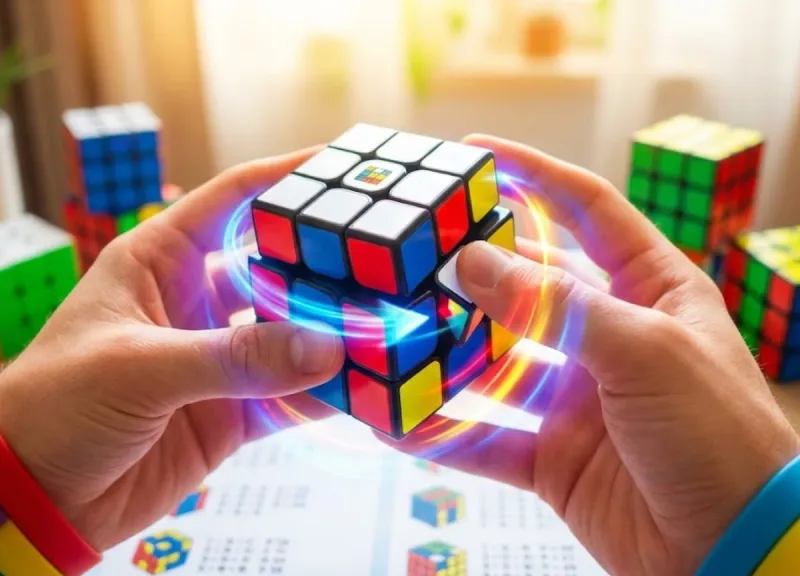
If you're consistently solving your Rubik's Cube in under two minutes with the beginner's method, you're ready for the next big step: First Two Layers (F2L). F2L is the cornerstone of the popular CFOP method and the single biggest leap you can make to slash your solve times.
In the beginner's method, you solve the first layer, then the middle layer edges. F2L combines these two steps. You locate a corner and its corresponding edge piece in the top layer and then insert them into their correct slot simultaneously. You repeat this four times to solve the first two layers at once.
There are 41 possible F2L cases, but don't be intimidated! Most can be solved intuitively. They all boil down to three basic scenarios for your corner and edge pair in the top layer.
The corner and edge are already connected correctly. This is the easiest case. You simply rotate the top layer until the pair is ready to be inserted into its slot.
The corner and edge are not connected. You need to perform a few moves to join them into a pair, then insert them.
The corner and edge are connected, but incorrectly (e.g., colors don't match up). You must first separate them, then join them correctly before inserting.
Learning F2L is a commitment, but the reward is immense. It's the bridge that takes you from being someone who can 'do' the Rubik's Cube to someone who can 'solve' it. Mastering F2L is the key to breaking the one-minute barrier and beyond, paving the way for you to learn the full OLL and PLL algorithm sets.
Ready to dive deeper? Check out our full F2L algorithm database for detailed guides on every case.