7 Stunning Mirror Cube Patterns That Will Look Amazing on Your Shelf
Transform your Mirror Cube into art! Discover 7 stunning patterns like the Superflip and Cube-in-a-C...
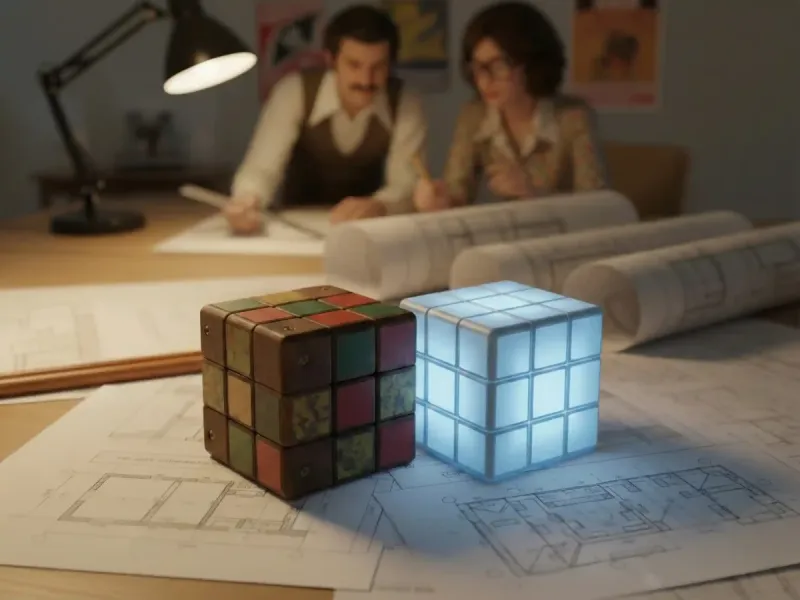
It was 1974 in Budapest, Hungary, when a young architecture professor named Ernő Rubik set out to solve a structural problem. He wanted a way to model three-dimensional movement for his students, something that could allow independent parts to move without the entire mechanism falling apart. What he ended up creating—after weeks of tinkering with wood, rubber bands, and paperclips—was the first working prototype of the "Magic Cube" (Bűvös Kocka).
Legend has it that Rubik himself didn't know if the puzzle could actually be solved once he scrambled it. It took him over a month of intense logic and mathematics to return his invention to its original state. Little did he know that his classroom tool would soon become the world’s most popular toy.
The puzzle was rebranded as the "Rubik’s Cube" and launched internationally in 1980 by the Ideal Toy Corp. The craze was immediate and overwhelming. It wasn't just a toy; it was a cultural icon of the 80s. From schoolyards to high-stakes competitions, everyone was trying to master the 43 quintillion possible permutations.
By 1982, more than 100 million cubes had been sold worldwide. However, the initial design was stiff and prone to jamming—a far cry from the high-performance hardware we use today. Early cubers had to use petroleum jelly or silicone sprays just to make the layers turn smoothly.
As the initial fad cooled down in the late 80s, a dedicated underground community kept the spirit alive. They developed advanced algorithms like the Fridrich Method (CFOP), which drastically reduced solve times. This demand for speed led to a revolution in hardware. Manufacturers began experimenting with internal rounded corners, adjustable tensions, and eventually, the introduction of magnets to stabilize turns.
Today, for best results and to achieve competitive times, modern speedcubers rely on precision-engineered hardware. For example, a popular choice among speedcubers is the GAN 356 M, which features a sophisticated magnetic system that provides the perfect balance of speed and control.
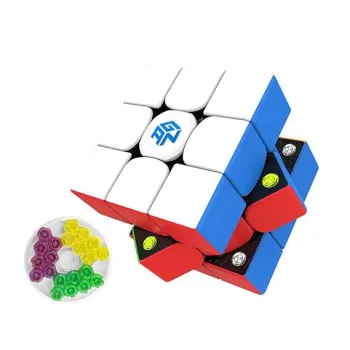
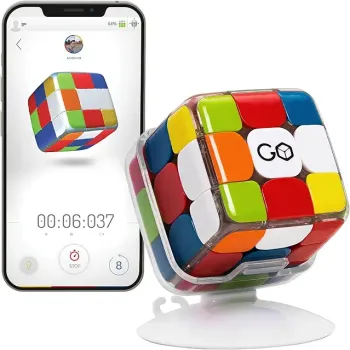
In the last decade, the Rubik's Cube has entered the digital age. We have moved beyond simple mechanical puzzles to "Smart Cubes" that connect via Bluetooth to your smartphone. These devices track your turns in real-time, offer personalized coaching, and allow you to race against cubers across the globe instantly.
If you're looking to bridge the gap between classic puzzles and modern technology, the GoCube Edge is an excellent choice for learning and competing in the 21st century. It transforms the solitary act of solving into a connected, social experience.
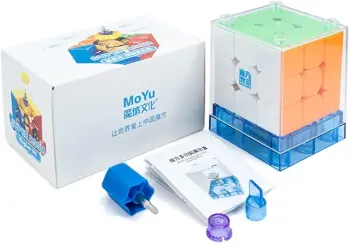
Whether you are a beginner fascinated by the history or a seasoned pro looking for your next main, having the right cube makes all the difference. Here are our top picks for modern performance:
From a wooden prototype in Budapest to the magnetic, Bluetooth-enabled wonders of today, the Rubik’s Cube remains a testament to human curiosity and our love for a good challenge. Grab a cube today and become a part of this continuing history!