How Solving Rubik's Cube Improves Your Child's Brain Development

Anita Tom

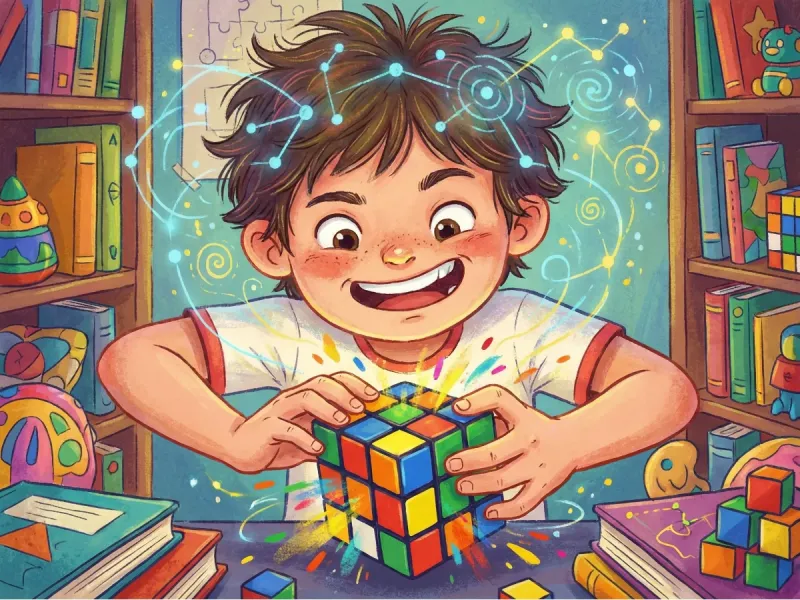
In today's digital age, finding activities that genuinely benefit children's cognitive development can be challenging. While screens dominate their attention, one classic puzzle continues to prove its worth: the Rubik's Cube. This colorful 3D puzzle isn't just a toy—it's a powerful tool for brain development.

The Science Behind Puzzle Solving and Brain Development

Research consistently shows that solving puzzles like the Rubik's Cube activates multiple areas of the brain simultaneously. When children engage with this puzzle, they're not just playing—they're building crucial neural pathways that will serve them throughout life.

8 Ways Rubik's Cube Enhances Cognitive Skills

1. Improves Problem-Solving Abilities

Every scrambled cube presents a unique problem to solve. Children learn to:

  • Break down complex problems into manageable steps
  • Think several moves ahead
  • Develop systematic approaches to challenges
  • Learn from mistakes and adjust strategies

2. Enhances Spatial Intelligence

Manipulating the cube helps children develop spatial reasoning—the ability to visualize and mentally manipulate 3D objects. This skill is crucial for:

  • Mathematics and geometry
  • Architecture and engineering
  • Computer programming and game design
  • Everyday tasks like packing and navigation

3. Boosts Memory and Recognition

Learning algorithms and recognizing patterns strengthens both short-term and long-term memory. Children develop:

  • Pattern recognition skills
  • Muscle memory through repeated movements
  • Ability to memorize sequences of 20+ moves
  • Visual memory for color patterns

4. Improves Hand-Eye Coordination

The physical manipulation of the cube requires precise finger movements coordinated with visual input. This improves:

  • Fine motor skills
  • Finger dexterity and speed
  • Bilateral coordination (using both hands together)
  • Reaction time and precision

5. Builds Patience and Perseverance

Unlike instant digital gratification, solving a Rubik's Cube takes time and effort. Children learn:

  • The value of persistent effort
  • How to handle frustration constructively
  • That complex goals require step-by-step progress
  • The satisfaction of achieving difficult goals

6. Enhances Focus and Concentration

Solving the cube requires sustained attention. Regular practice helps children:

  • Block out distractions
  • Maintain focus for extended periods
  • Develop mindfulness and present-moment awareness
  • Improve attention span for other academic tasks

7. Develops Strategic Thinking

Advanced solving methods teach children to think strategically:

  • Planning multiple steps ahead
  • Recognizing optimal vs. suboptimal solutions
  • Understanding cause and effect relationships
  • Making decisions under time pressure (in speedcubing)

8. Builds Confidence and Self-Esteem

Successfully solving a Rubik's Cube is a significant achievement. It helps children:

  • Develop a growth mindset
  • Believe in their ability to learn difficult skills
  • Gain recognition from peers and adults
  • Feel proud of mastering something challenging

The Right Age to Start

Most children can start learning the Rubik's Cube around age 6-8, though some begin earlier with simpler 2×2 cubes. The key is ensuring the activity remains fun rather than frustrating.

Academic Benefits

Studies have shown that children who regularly solve Rubik's Cubes often show improvements in:

  • Mathematics: Better understanding of algorithms, sequences, and spatial concepts
  • Science: Enhanced analytical thinking and hypothesis testing
  • Reading: Improved pattern recognition helps with letter recognition
  • Test-taking: Better focus and problem-solving under pressure

Social and Emotional Development

Beyond cognitive benefits, the Rubik's Cube community offers:

  • Opportunities to connect with like-minded peers
  • Participation in competitions and events
  • Learning to handle success and failure gracefully
  • Developing teaching skills by helping others

How Parents Can Support Their Child's Journey

  • Start with beginner-friendly methods like the layer-by-layer approach
  • Celebrate small milestones, not just the final solve
  • Use online tutorials and resources together
  • Consider joining local cubing clubs or online communities
  • Make it a screen-free, quality bonding activity

Conclusion

The Rubik's Cube is more than a nostalgic toy from the 1980s—it's a scientifically proven brain-training tool that offers lasting cognitive benefits. In an era where children's attention is constantly divided, this humble puzzle provides focused, engaging, and beneficial entertainment.

Ready to get your child started? Check out our beginner's guide and watch their cognitive abilities flourish!