Rubik's Cubes in the Classroom: The Ultimate STEM Education Tool
Discover how the Rubik's Cube is transforming STEM education. Learn how teachers use the puzzle to t...
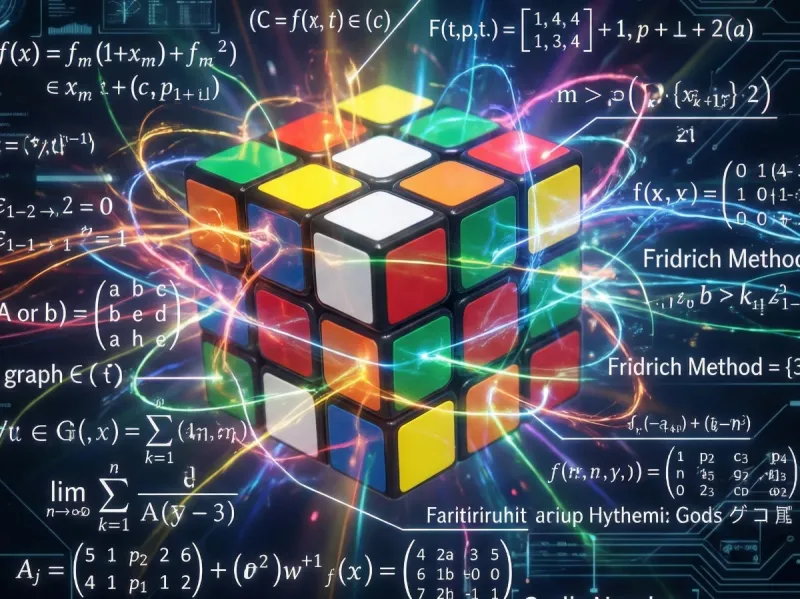
The Rubik's Cube is not just a puzzle—it's a mathematical marvel that has fascinated mathematicians, computer scientists, and puzzle enthusiasts for decades. At first glance, it might seem like a simple toy with colored squares, but beneath its surface lies an astounding mathematical complexity.
The standard 3×3×3 Rubik's Cube has exactly 43,252,003,274,489,856,000 possible combinations. That's approximately 43 quintillion different states the cube can be in! To put this in perspective:
The calculation involves several mathematical principles:
There are 8 corner pieces, each with 3 possible orientations. The number of permutations is:
There are 12 edge pieces, each with 2 possible orientations:
Not all mathematical combinations are physically possible. Due to the cube's mechanical constraints:
The complete calculation is:
(8! × 3^7 × 12! × 2^11) ÷ 12 = 43,252,003,274,489,856,000
Despite the massive number of combinations, mathematicians proved in 2010 that any scrambled cube can be solved in 20 moves or fewer. This is known as "God's Number." Using the power of supercomputers and advanced algorithms, researchers tested every single possible position to confirm this remarkable fact.
Other Rubik's Cube variants have even more mind-boggling numbers:
The mathematics behind the Rubik's Cube demonstrates the beautiful intersection of group theory, combinatorics, and computer science. What appears as a simple children's toy is actually a gateway to understanding complex mathematical concepts. Whether you're a speedcuber aiming for faster solve times or a mathematician exploring permutation groups, the Rubik's Cube continues to offer endless fascination.
Ready to start solving? Check out our beginner's tutorial to learn how to conquer any of those 43 quintillion combinations!